"Restore" - Some paintings begin with a clear destination.
Some paintings begin with a clear destination. Others begin with a question.

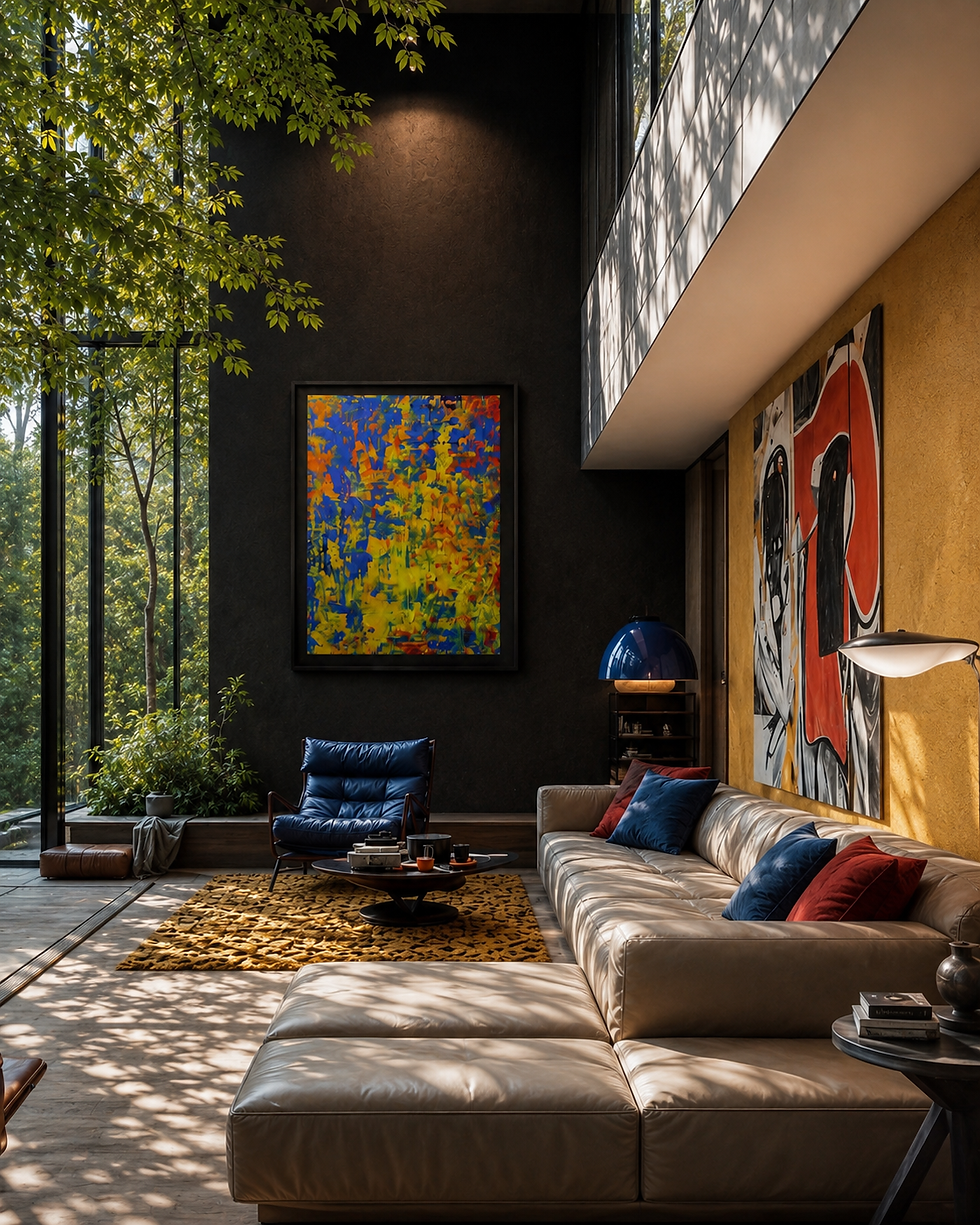
Restore is a 4-by-5-foot mixed-media painting that lives somewhere between construction and deconstruction, creation and excavation. At first glance, viewers often ask the same question: What happened here?

The answer depends on where you choose to begin.
Is this a yellow painting that has been sanded, scraped, and worn away over time, revealing traces of a forgotten blue history beneath its surface?

Or is it a blue painting in the process of becoming something new, slowly disappearing beneath layers of yellow paint applied by an unseen hand?
The painting never fully answers.
Instead, it invites the viewer into the space between those possibilities.
Across the surface, layers of vibrant yellow stretch and fracture, exposing hints of electric blue that emerge like memories, artifacts, or remnants of an earlier life. Areas appear weathered and restored simultaneously. Marks suggest erosion, while other passages feel intentional and freshly constructed.


The tension between those opposing forces creates the energy of the piece.
One of the most distinctive elements of Restore is its dimensional surface. Built through numerous layers of paint, texture, and epoxy resin, the painting extends beyond a traditional flat canvas. The blue passages exist above the final resin layer, creating a visual experience that shifts as light moves across the work. Shadows form. Highlights emerge. Surfaces reveal themselves differently throughout the day.

The result is a painting that refuses to sit still.
Threading through the composition is the artist's signature black line work—an element that has become a recurring visual language throughout the collection. The lines act as both structure and interruption. They connect fragmented areas while simultaneously dividing them, creating pathways for the eye to explore and reconsider what is happening beneath the surface.

Like restoration itself, the painting is not about returning something to its original condition.
It is about transformation.
The word "restore" often implies going backward. This piece suggests the opposite. Restoration can be an act of moving forward. Layers are not removed to erase history; they are revealed to acknowledge it. New layers are not added to conceal the past; they become part of a larger story.


In that sense, Restore becomes less about paint and more about experience.
We are all layered. We all carry traces of previous versions of ourselves. Some remain hidden beneath the surface. Others break through unexpectedly. We build. We remove. We repair. We evolve.
The painting captures that ongoing process.
Standing in front of Restore, viewers often find themselves searching for the beginning layer, the true surface, the original story. Yet the longer they look, the more apparent it becomes that every layer is part of the final work.
Nothing has been lost.
Everything remains.

The painting is not documenting restoration.


